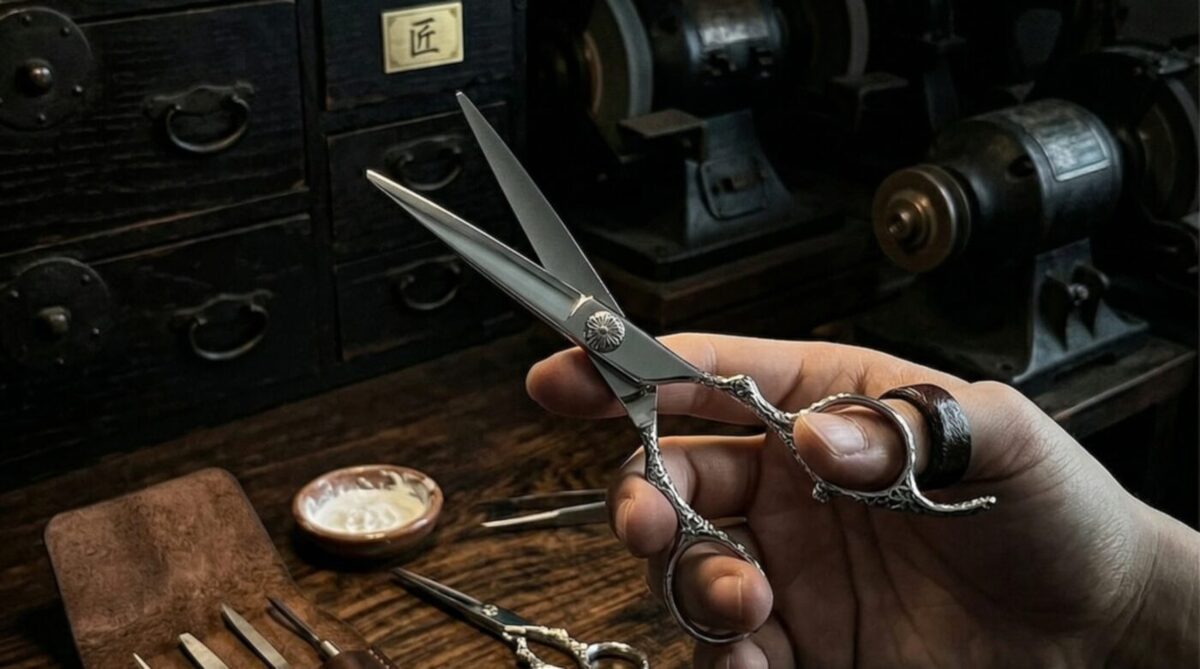
Thinning scissors are specialist tools for reducing volume. They don't just "cut hair" — they're designed to control how much hair is cut per stroke, and the tooth count, tooth shape, and thinning ratio all change the result.
How thinning scissors work
A thinning scissor has one normal blade (usually convex or bevel) and one toothed blade. The normal blade cuts hair; the teeth let hair slip through. In a single stroke, part of the hair bundle is cut and the rest passes through intact. This is what makes thinning feel different from cutting.
Tooth count
Thinning scissors are often described by tooth count — the number of teeth on the toothed blade. Tooth count affects the result, but it does not determine removal rate on its own; tooth shape, spacing, groove design, blade condition, section size, and technique also matter.
| Teeth | General tendency | Characteristics | Common use |
|---|---|---|---|
| 10–15 | Often higher removal per pass | Widely spaced, chunker-style teeth | Bulk removal and strong texture |
| 20–25 | Often medium-to-high removal | Broader spacing with more control | General volume adjustment |
| Around 30 | Often moderate removal | Closer spacing and a more blended result | General thinning and texture work |
| 40+ | Often lower removal per pass | Fine, closely spaced teeth | Blending and surface texture |
30-tooth vs 40-tooth
Around 30 teeth is a common general-purpose configuration, but removal rate varies substantially between designs. Treat tooth count as a starting point, not a percentage guarantee.
Models with 40 teeth or more are often used for finer blending and surface texture. The visible result still depends on tooth geometry, section size, hair type, and technique.
Chunkers (volume removal)
Chunkers have relatively low tooth counts and wider spacing, so they generally remove more hair per pass than a fine-tooth thinner. They are often used for bulk reduction and stronger texture.
Wide spacing can leave a more visible result, especially on fine sections or when repeated in one area. Some stylists follow with a finer thinner to soften transitions; the appropriate workflow depends on the cut and hair type.
What "thinning ratio" means
Thinning ratio is a maker's estimate of how much hair a model removes under particular test conditions. It is useful for comparison, but a stated percentage will not produce the same result on every section of hair.
Ratio is affected by tooth shape, spacing, groove design, blade condition, and technique. Two 30-tooth scissors can therefore behave very differently. Use the specifications guide for general selection context, then confirm the current model's tooth count and stated removal rate with an approved distributor.
Tooth shapes
Thinning teeth come in several shapes:
- V-shape — V-shaped gaps between teeth. Most common, versatile.
- U-shape — rounded tooth tips. Leaves a softer, less-visible mark.
- Stepped — teeth at varying depths, creating more complex texture effects.
- Stopper teeth — small protrusions at the tooth root that prevent hair from over-passing.
Choosing a thinning scissor
Basic matching:
- Primarily removing bulk — 10–20 tooth chunker
- Everyday thinning — 25–30 tooth general thinner
- Texture and dry work — 30–40 tooth refined thinner
- Blending and men's detail work — 40+ tooth texturizer
Some stylists use more than one thinning scissor for different results. If you are choosing a first or additional model, compare it in person where possible and ask an approved distributor about its intended use.
Thinning scissor maintenance
Like cutting scissors, thinning scissors need to be wiped after use and oiled periodically. Hair and product build-up between the teeth dulls performance quickly — use a soft brush to clear the tooth gaps.
Servicing a thinning scissor requires the tooth geometry and cutting blade to be assessed together. Use a technician with specific experience in professional thinning scissors, and confirm service options with an approved distributor if unsure.