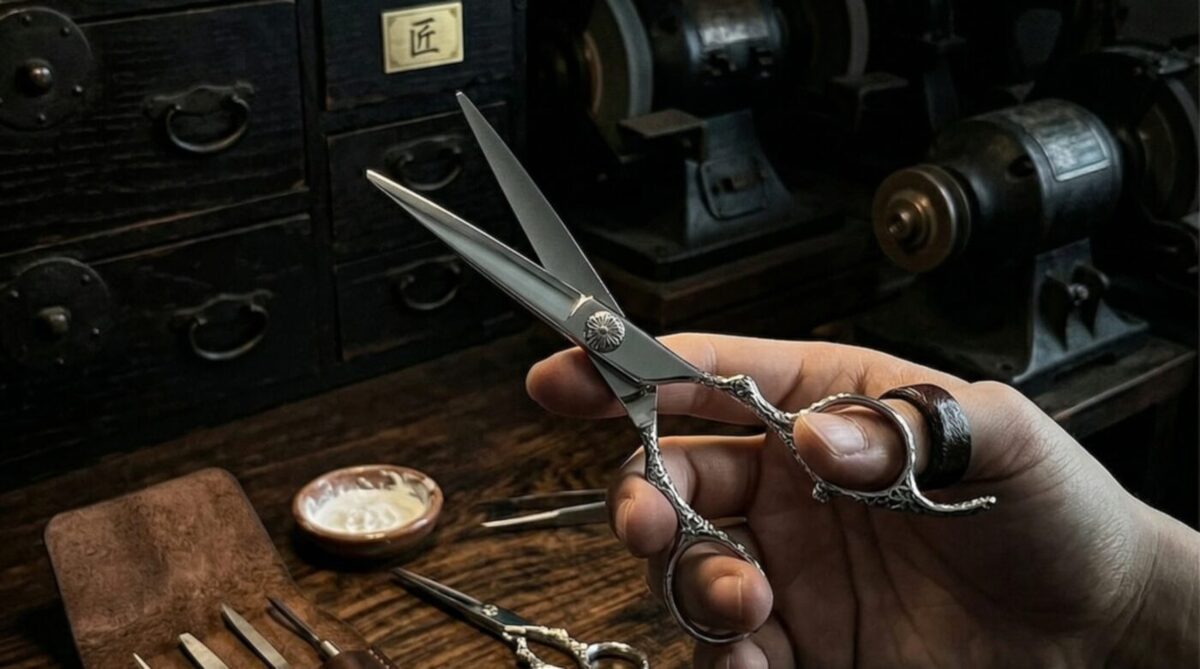
Professional stylists repeat the same scissor movement throughout the working day. Handle fit, tension, weight, balance, posture, and technique all influence comfort, and no single design is right for every person.
True left-handed design
For a left-handed stylist, a purpose-built left-handed scissor can improve blade visibility, control, and fit compared with adapting a right-handed model.
Mirrored handles aren't enough
A purpose-built left-handed scissor considers more than the handle shape. Compare these elements:
- Handles — thumb and finger rings positioned for left-hand grip
- Blade orientation — upper and lower blades arranged so they cut correctly when held in the left hand
- Tension mechanism — adjustment method appropriate to the model and its intended grip
Blade orientation affects the sight line and the pressure applied as the blades close. A true left-handed model reverses the blade relationship so it works as intended with a natural left-handed grip.
Ask an approved distributor to identify the current Ichiro models made for left-handed use and to confirm their blade and handle configuration.
Tension adjustment
The tension between the two blades — set by the pivot mechanism — affects how they meet and how the action feels. Too loose can reduce cutting control; too tight can make opening and closing feel unnecessarily heavy.
Checking tension
Follow the instructions supplied for the model. A controlled drop test can provide a starting indication, but there is no single closing angle that applies to every scissor.
- Possibly too loose — the blades fall fully closed with little control
- Possibly too tight — the blades do not move and the action feels heavy
- Useful starting point — the moving blade closes part of the way in a controlled motion
The adjustment mechanism varies by model. Use only the specified tool and make small changes; never force the mechanism. If the blades fold hair, catch, or feel uneven after adjustment, stop using the scissor and ask an approved distributor or experienced scissor technician to check it.
Tension drifts over time
Tension can change with use. Check it when the action begins to feel different, after an impact, or as directed for the model rather than relying on a fixed schedule.
Weight and balance
A scissor's weight on a spec sheet doesn't tell you how it actually feels in the hand. Two 60-gram scissors can feel completely different depending on where their center of gravity sits.
A well-matched scissor feels controlled rather than noticeably front-heavy or rear-heavy. The preferred balance point varies with hand size, grip, and technique.
Finding the balance point
Supporting a closed scissor carefully near the pivot can show whether its weight tends toward the blade or handle. This is only a comparison aid: the most useful test is how the model feels in your normal grip and cutting position.
Supporting comfort during repetitive work
General points to consider:
- Handle shape — compare offset, crane, and level handles in your normal working position rather than choosing by category alone.
- Thumb position — avoid forcing the thumb deeply into the ring; inserts and ring size can change the fit.
- Elbow and shoulder position — adjust the client chair and your working height to reduce unnecessary reaching.
- Work pattern — vary tasks and take appropriate breaks in line with your workplace guidance.
- Weight — choose a weight that feels controlled and stable for your technique, not simply the lightest option.
Tool choice and professional advice
Tool choice can support comfort, but it cannot prevent or treat an injury. Persistent pain, numbness, weakness, or reduced movement should be discussed with a qualified health or occupational professional.
When choosing an Ichiro scissor, consider handle shape, tension adjustment, weight, balance, dominant hand, and intended technique. Where possible, compare models through an approved distributor before ordering.