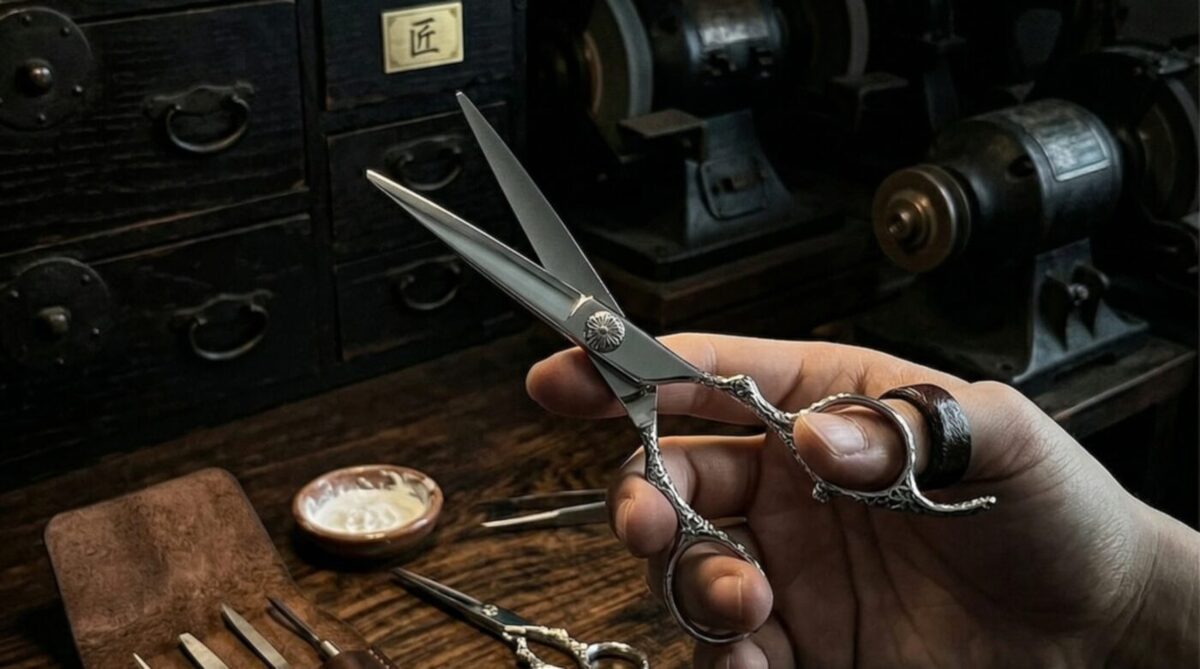
Steel grade is one part of a professional hair scissor's performance. Edge geometry, heat treatment, assembly, and maintenance also affect sharpness, edge retention, corrosion resistance, and how the blade responds to sharpening.
Common steels in professional hair scissors
These are examples of steel names commonly encountered when comparing professional hair scissors. A grade name alone does not confirm a finished scissor's hardness or performance.
VG-10
VG10 is an original stainless blade steel from Takefu Special Steel. Takefu's published composition includes chromium, molybdenum, vanadium, and cobalt, and the company lists knives and machine blades among its applications.
- Published hardness: Takefu lists VG10 at HRC 60 or above; finished hardness depends on heat treatment
- Published characteristics: corrosion resistance, wear resistance, machinability, and ease of sharpening
- Published applications: kitchen knives, general-purpose knives, and machine blades
ATS-314
ATS314 is a proprietary stainless cobalt-alloy scissor steel specified by Yamamura Manufacturing and produced for it by Proterial (formerly Hitachi Metals). Yamamura states that ATS314 is distinct from ATS34; its full formulation is not publicly disclosed.
- Hardness: depends on the finished product and heat treatment
- Published characteristics: high hardness and wear resistance
- Published application: professional hair-scissor material
SUS440C
SUS440C is a high-carbon stainless-steel designation used for cutlery and other wear-resistant applications. Its finished hardness and cutting characteristics depend on heat treatment, blade geometry, and manufacturing quality.
- Hardness: varies by heat treatment and finished product
- Characteristics: stainless steel with a useful balance of hardness, wear resistance, and corrosion resistance
- Applications: cutlery and other precision cutting products
Cobalt alloys
"Cobalt scissors" is a broad market term for scissors made with a cobalt-bearing steel. It is not a single grade or performance standard: composition, heat treatment, and finished hardness vary by supplier and model. Compare the named steel and model specification rather than relying on the category label alone.
Rockwell hardness (HRC) explained
HRC (Rockwell C scale) is a common measure of metal hardness. A higher reading indicates greater hardness, but it does not by itself predict edge retention, toughness, corrosion resistance, or cutting feel.
Many professional hair scissors are marketed within roughly the high-50s to low-60s HRC range. Treat that as context rather than a universal target: the appropriate hardness depends on the steel, heat treatment, blade geometry, and intended use.
| HRC | Characteristics | How to interpret it |
|---|---|---|
| Below 55 | Relatively soft; may be easier to sharpen | Interpret with the steel and product specification |
| 56–57 | Moderate hardness | Interpret with the steel and product specification |
| 58–60 | Commonly listed for professional scissors | Balance still depends on geometry and heat treatment |
| 60–62 | Higher hardness | Toughness and edge behaviour remain steel-dependent |
| 63+ | Very high hardness | Requires product-specific assessment |
Corrosion resistance and daily care
"Stainless" does not mean "rustproof". Premium steels can still develop corrosion or staining when exposed to moisture or salon chemicals without appropriate care.
Conditions that shorten steel life:
- Leaving hair color or perm solution on the blades after use
- Storing the scissor while still damp
- Contact with salt or acidic substances
- Extended storage in humid environments
Clean and dry the blades after use, and lubricate the pivot according to the model's care guidance. See the maintenance page for more context.
Heat treatment matters too
Steel grade is important, but so is heat treatment — the hardening and tempering process that turns raw steel into a working blade. Two scissors made from the same steel can end up with different hardness, different grain structures, and different feels, depending on how each was heat-treated.
Before dispatch, Ichiro scissors are checked for alignment, pivot tension, and finish. For the steel grade and hardness of a current model, confirm the product specification with an approved distributor.