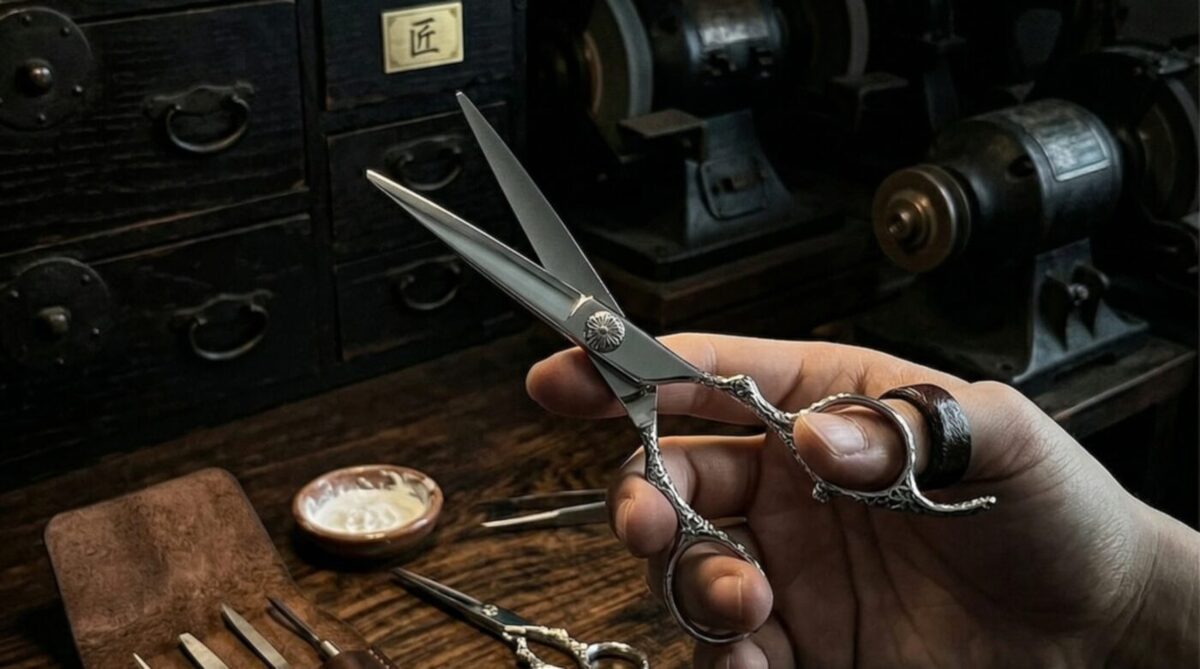
Handle shape affects grip, working position, and how a scissor feels over a session. Fit is individual, so these categories are useful starting points rather than health or comfort guarantees.
Offset handle
The offset handle is the most common shape in modern professional hair scissors. The thumb ring sits forward of the ring finger ring, reducing how far your thumb has to extend while cutting.
Compared with a symmetric (straight) handle, an offset design reduces how far the thumb must reach. Some stylists find that this supports a more neutral working position, but comfort depends on hand size, grip, posture, and technique.
Many Ichiro cutting models use some version of an offset design. Confirm the handle geometry of a current model with an approved distributor.
Crane handle
The crane handle pushes the offset idea further. The angle between the finger ring and thumb ring is more pronounced, encouraging a lower hand position. Some stylists prefer this shape for blow-dry cutting, layered cuts, or techniques that otherwise require more wrist movement.
Offset vs crane — how to choose
Think of offset as "thumb ring set slightly forward" and crane as "thumb ring set substantially forward". Neither is better in absolute terms — it depends on your cutting style, posture, and preference. Many stylists own both and use them for different techniques.
Level (straight) handle
The level handle is the traditional symmetric design, with the thumb and ring finger rings on the same horizontal line. Ichiro's catalog features few of these, but they still exist for stylists who prefer the classic feel or use them for specific techniques.
A level handle offers visual symmetry and a familiar straight grip. Symmetric handles do not make a right-handed blade suitable for left-handed use, and comfort over a long session varies by person. These handles are often chosen for particular barbering methods or an established cutting technique.
Swivel thumb
A swivel-thumb handle replaces the fixed thumb ring with one that rotates independently. This gives the thumb another range of movement, which some stylists find comfortable during point cutting, slide cutting, and other techniques involving changes in hand angle.
Swivel mechanisms have more moving parts than fixed handles. Follow the model's care instructions and ask the seller which points, if any, should be lubricated or adjusted.
Decorative handles
Some handles use sculpted rings, ornamental pivots, or other decorative details. These are aesthetic descriptions rather than a single technical geometry, and older collection names do not confirm current availability.
Confirm the handle layout, blade, steel, finish, weight, and current availability of the individual model before ordering.
Handle surface finishes
Surface finish can affect appearance, care, and grip feel. Examples include:
- Polished finish — a reflective surface that can show fingerprints and water spots.
- Satin or brushed finish — a lower-reflection surface with a visible directional texture.
- Colour coating — an applied finish whose composition and availability vary by model. A colour name does not establish allergy suitability; ask an approved distributor to confirm the coating composition if you have a known sensitivity.
See the finish-selection guidance, then ask a distributor what is currently offered.
How to choose
There's no universal right answer here. The honest questions to ask yourself:
- How many hours per day do you hold your scissors?
- Which working positions feel comfortable and controlled?
- Is your primary technique blow-cut, scissor-over-finger, or slide cutting?
- Does your current handle shape feel natural, or do you notice it?
If you're unsure, compare a few shapes in person through an approved distributor. A short dry fit can help, but assess the model using your normal grip and working position before deciding.