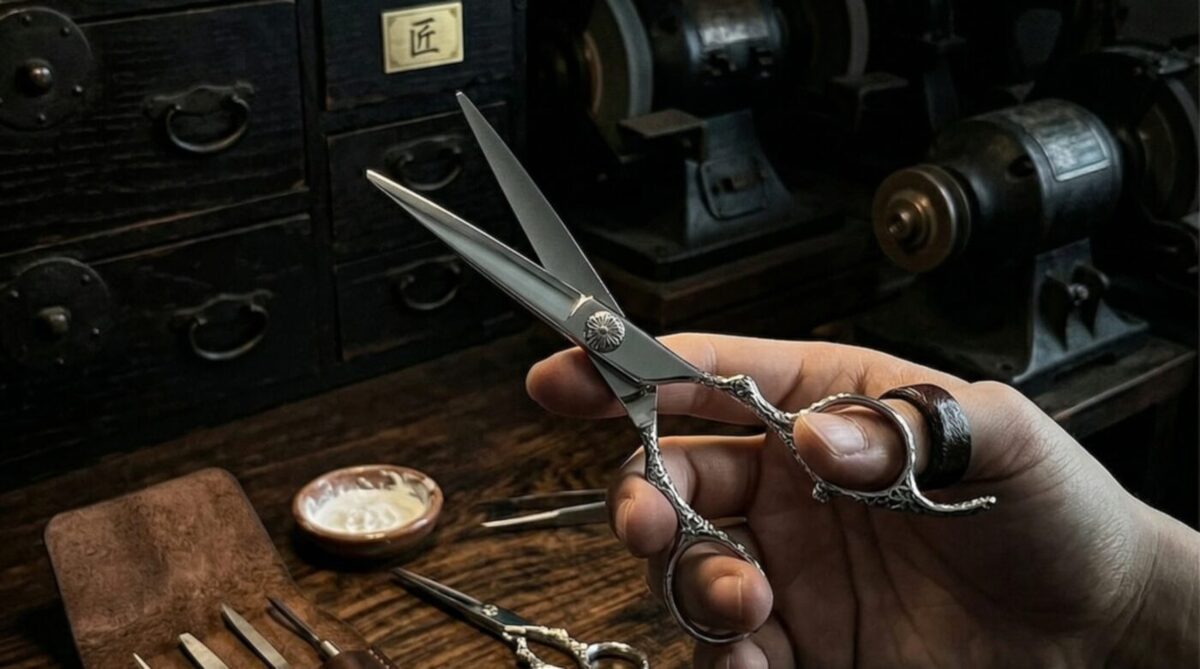
Regular cleaning, drying, lubrication, safe storage, and appropriate servicing help a professional hair scissor perform consistently. The right routine depends on the model, workload, salon products, and local hygiene requirements.
After every use
The most important habit is the simple wipe-down after each day.
1. Remove hair and residue
Immediately after use, wipe the blades with a soft cloth — microfibre or cotton. Pay particular attention to the pivot area, where hair and styling product tend to collect.
Hair colour, perm solution, bleach, and styling residue can mark the finish or contribute to corrosion if left on the blades. Remove residue promptly, following the care instructions for the model.
2. Dry completely
If the blades are wet from a shampoo cut or after cleaning, dry them fully before storing. Moisture trapped around a closed blade or pivot can contribute to corrosion.
3. Store correctly
Use a protective scissor case or stable stand. Avoid carrying an unprotected scissor in a pocket or leaving it where it can fall; impact can affect the edge, alignment, or pivot.
Oiling
Scissors are precision mechanisms and may require lubrication at the pivot. Compatible lubricant helps the blades move smoothly and reduces friction at the joint.
How often
There is no universal interval. Follow the model's care instructions and consider workload, cleaning frequency, humidity, and how the pivot feels. Inspect the joint after cleaning and when the action begins to feel dry or uneven; if you are unsure, ask an approved distributor.
How to oil
- Open the scissor fully
- Apply a small amount of the specified scissor lubricant to the pivot
- Open and close the scissor several times to work the oil in
- Wipe off excess oil with a soft cloth
Use a lubricant recommended for the model. Avoid substituting cooking oil or an unspecified general-purpose product, as compatibility with the pivot and finish can vary.
Tension adjustment
Check tension when the action changes, after an impact or servicing, or when the model guidance calls for it; do not adjust it on a fixed schedule. The assessment steps are covered on the ergonomics page. If adjustment does not restore a smooth, even action, stop using the scissor and seek professional advice.
Sharpening
Sharpening is unavoidable in a professional's life with scissors. No matter how premium the steel, edges wear with use.
When to sharpen
Watch for these signs:
- Hair pulls instead of cutting cleanly
- Slide cutting stalls or catches
- The "click" when the blades close sounds dull
- Visible nicks or discoloration on the edge
Sharpening frequency
Use condition rather than a fixed calendar. Workload, steel, blade geometry, maintenance, and technique all affect service needs. An experienced scissor technician can advise after inspecting the edge and alignment.
Convex edges need specialists
Sharpening a convex edge is a different skill from sharpening a knife or a bevel-edge blade. Maintaining the subtle curve of the convex geometry requires dedicated equipment and experience.
An unsuitable sharpening process can alter a convex profile. Use a technician who can explain their experience with convex hairdressing scissors and how they will preserve the blade geometry.
Ask the original seller or an approved distributor to confirm the current service route before shipping. See the sharpening guidance for the information to check first.
Things to avoid
- Cutting unsuitable materials — paper, string, and other non-hair materials can accelerate edge wear or cause damage.
- Impact — a drop onto a hard surface can affect the edge, alignment, or pivot even when damage is not obvious.
- Sharing without a hygiene process — follow your salon's hygiene policy and local requirements, and recheck fit and tension before use.
- Unverified cleaning chemicals — confirm that a disinfectant is compatible with the steel, coating, inserts, and lubricant, then follow its contact-time and removal instructions.
Periodic professional checks
Ask an approved distributor or experienced scissor technician to inspect the tool when performance changes or as recommended for the model. A professional check can cover tension, edge condition, alignment, pivot wear, and the handle finish.
Consistent, model-appropriate care helps preserve cutting performance and makes changes easier to identify before further damage occurs.